Human Vision · Claude Engineering · Real Products
Across all three products, Claude Code worked from the owner's instructions and left a trail: the instruction, the recorded action, and the source or asset that survives it. That trail is what this page shows. It is development assistance. None of the products runs on Claude, and none of this implies Anthropic's endorsement.
Verbatim owner messages, Claude Code tool actions that completed successfully, current source and surviving media. Each record carries a number and a hash so the owner can trace it. Raw transcripts are never published.
Development ≠ runtime. Claude helped build the apps. The apps do not call Claude to analyse hair or to swap products.
The character system, the pre-scan preview and the Hello timing were moved into the real React Native app by Claude Code, on the owner's instructions. Claude is credited for the integration and the timing, not for the character's pixels, which come from the project's generated-asset workflow.
“Move the approved visual/motion system into the REAL HairTwin React Native app.”
Wrote LivePip.tsx and HelloScreen.tsx. The live Pip contract: whole renders with the hair already in them, a face that blinks and looks, a body that breathes.
“The user should feel this is the same evolving character they selected, not a reset to a random generic Pip.”
Wrote prescan-pure.ts and prescan.ts: Pip sketches the person's answers before the scan, as a preview, never as a result.
“Make the first transformation begin sooner.”
Install the new film atomically and update the Hello timing. PRE_ROLL_MS = 150 and BUBBLE_AT_MS = 330 survive in the source; the installed film's hash matches the original.
Later owner decisions in the same record set: 2 October, “current LIGHT post-scan design direction is approved as the foundation”; 6 October, “DESIGN PHASE ONLY.” and “This is the new approved direction.” Commits 16a9e2b, d31fad2 and d142318 carry Claude co-author trailers. HairTwin's development used a shared Claude and Codex workflow.
Supported wording: Claude-assisted character-system work, interface iteration, visual fidelity work and native motion choreographyClaude Code produced the design synthesis and screen builders, the design tokens, the Welcome timeline and the discovery and feed modules of the native app. The workflow hit a usage limit before native acceptance; Codex continued integration and tests, and the current source commits are Codex's.
“show me the final visual boards BEFORE implementation”
Screen builders and the synthesis of five proposals into Lit Stream; boards and recordings delivered for review first.
“Continue from the approved ‘Lit Stream’ direction.” · “DO NOT replace the visual language.” · “DO NOT simplify it back into generic black screens.”
Design tokens; welcomeTimeline.ts with LOOP_SEC = 12 and HERO_DURATION = 4.8; discoveryWorld.ts; feedSheetPin.ts.
Native acceptance was not completed in that workflow.
Continued integration and tests. Three diagnostic builds were captured on 8 October and are documented with their failures. Visual fidelity on the owner's device: not passed.
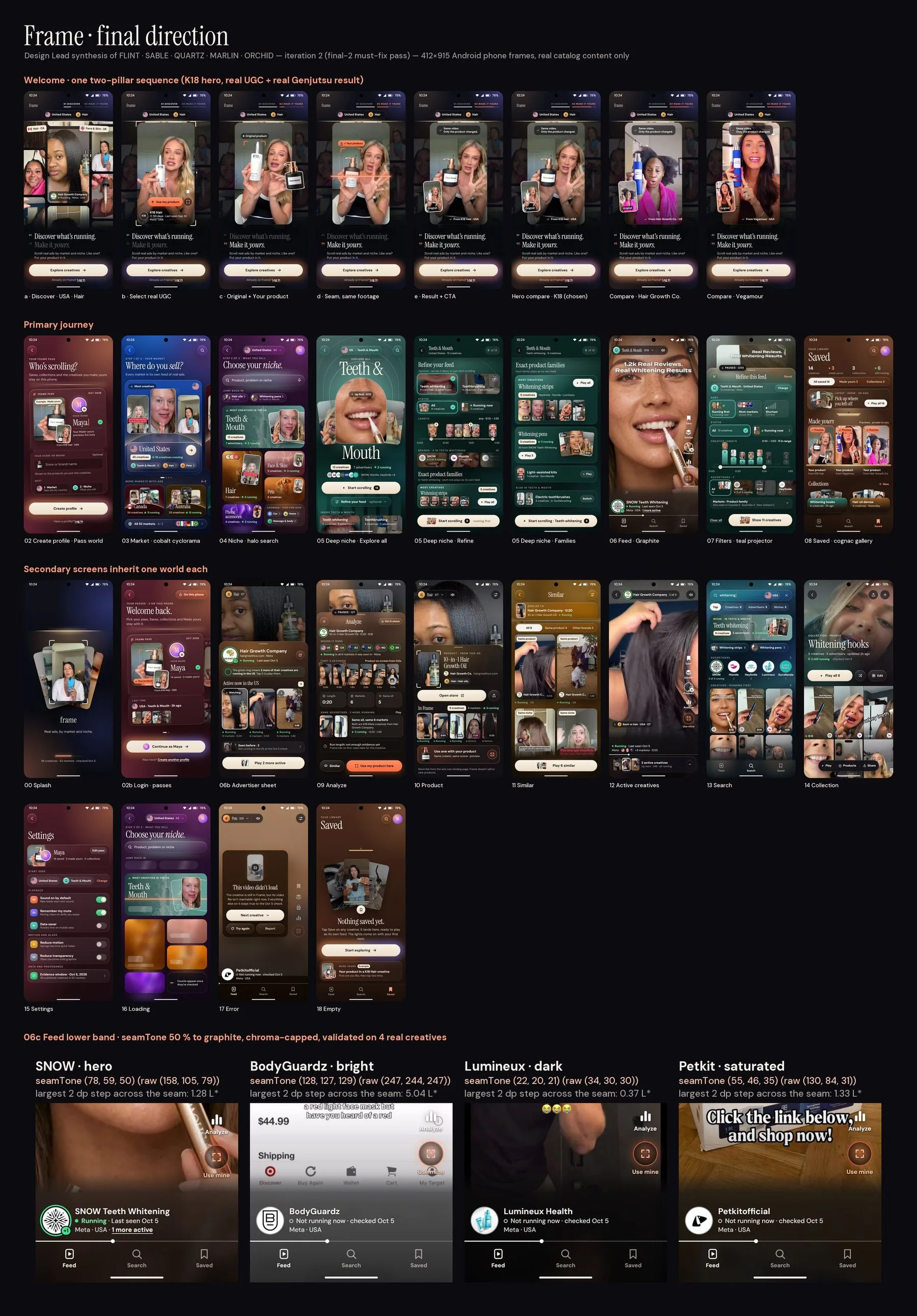
The design research behind it: about ninety 21st.dev searches, 223 Mobbin screens, Higgsfield explorations for the niche colour worlds, and three Genjutsu product-swap jobs approved by the owner for the Welcome study. Claude Design, the separate product, was not used for Frame.
Supported wording: “Developed with Claude Code” · “Claude Code contributed design tooling and native implementation”On a live store, the work was careful by instruction. Claude Code audited the design transfer, wrote a motion runtime and the Shopify-aware effects module, and added a one-line guard, if (!this.heal()) return;, to an animation tick that previously checked only this.dead. Codex and the Shrine commerce foundations carried the commerce layer and later integration.
“Preserve desktop, mobile, interactions, animations, live HTML copy, and placeholders.”
Retrieved the design and wrote a transfer audit. Created scrub.js, the motion runtime.
if (!this.heal()) return;
Added to the animation tick, which previously checked only whether it was dead. A precise repair, not a rewrite.
“DO NOT rebuild the Shopify implementation from scratch.”
Wrote ao-fx.js with reduced-motion handling and Shopify lifecycle hooks, inside the existing implementation.
Chronology: July film → August Claude source work → September approved design → October captures and macro. The August work did not cause the July output; no performance or conversion gain is claimed for the repair.